Skip to content

Product Suite

Business Intelligence

Specialist capability. Shared platform. Agentic execution.

Business Intelligence runs as part of the Advanze Execution Platform, so the application is not isolated software. It shares the same data foundation, workflow engine, security model and agentic AI fabric as the rest of the enterprise suite. Teams get the specialist capability they need without creating another silo.

Data and business teams reviewing analytics, resilience and recovery evidence.
Business Intelligence starts with people trying to make the right call. It starts with a person trying to get business intelligence work done without losing context. They need the next action to be clear, but they also need confidence that the platform has checked the risk, evidence, permissions and downstream impact.

Product Suite / Business Intelligence

From application to execution capability

Advanze is positioned around the idea that enterprise software must evolve from passive systems of record into active systems of execution. In that model, this page is not just a feature description. It explains how Business Intelligence contributes to an operating environment where people define intent, agents execute governed work, and leadership can see progress through unified data.

The value is strongest when the capability is connected to adjacent processes. Records, workflows, controls, communications and analytics should not live in separate tools. They should participate in a shared execution fabric that can coordinate work across departments while preserving human accountability.

Data and business teams reviewing analytics, resilience and recovery evidence.
Where Business Intelligence becomes real work people can trust. The person is no longer carrying the full burden alone. Agents assemble context, route specialist checks, pause when judgement is required and record what happened so Business Intelligence work feels calmer, faster and accountable.

Core capabilities

What Business Intelligence enables

Each capability is designed to work as part of the broader execution platform rather than as a disconnected module.

Multi-Dimensional Analysis (OLAP)

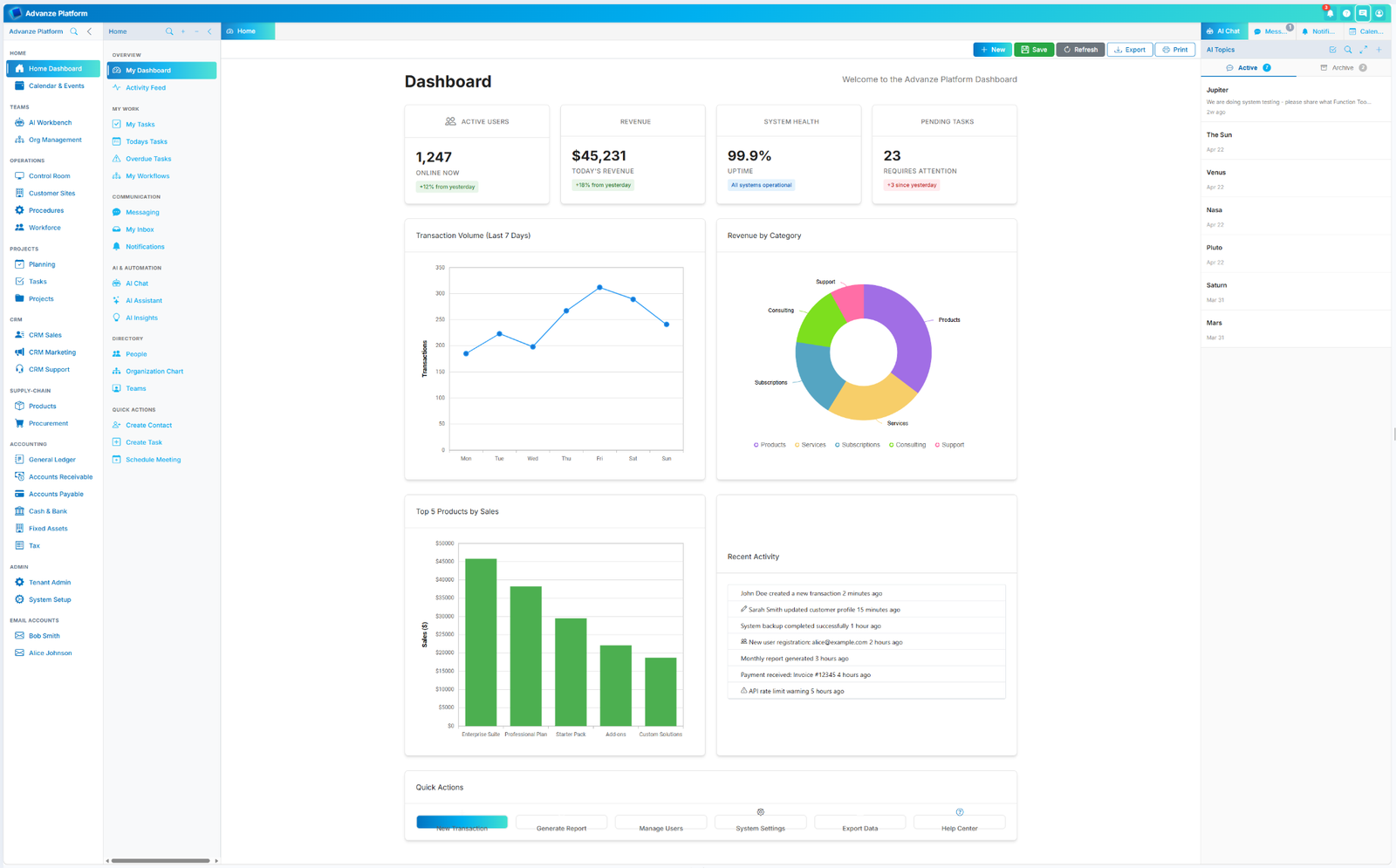
Explore data across multiple dimensions with slice, dice, drill-down, and roll-up capabilities. Agents pre-compute aggregations across common dimension combinations, enabling instant analysis of metrics by time, geography, product, customer segment, and custom hierarchies.

Self-Service Data Exploration

Empower business users to build ad-hoc analyses and reports without IT dependency. The platform provides governed data access with semantic layers that translate business terms into queries, while agents validate data logic and suggest relevant dimensions.

Predictive Analytics Integration

Combine historical analysis with forward-looking forecasts and trend predictions. AI agents apply statistical models and machine learning algorithms to historical patterns, generating predictions for demand, churn risk, revenue trends, and operational capacity.

KPI Monitoring and Alerting

Track critical business metrics against targets with automated threshold monitoring. Agents detect anomalies, compare performance across time periods and segments, and alert stakeholders when KPIs deviate from expected ranges or targets.

Executive Scorecards

Deliver consolidated performance views aligned with strategic objectives and balanced scorecard frameworks. Dashboards aggregate KPIs across departments, providing executives with enterprise-wide visibility into strategic goal achievement and operational health.

Governed Data Access

Control data visibility and report distribution based on roles, responsibilities, and security policies. Agents enforce row-level security, mask sensitive fields, and audit data access patterns, ensuring analytics capabilities don't compromise data governance requirements.

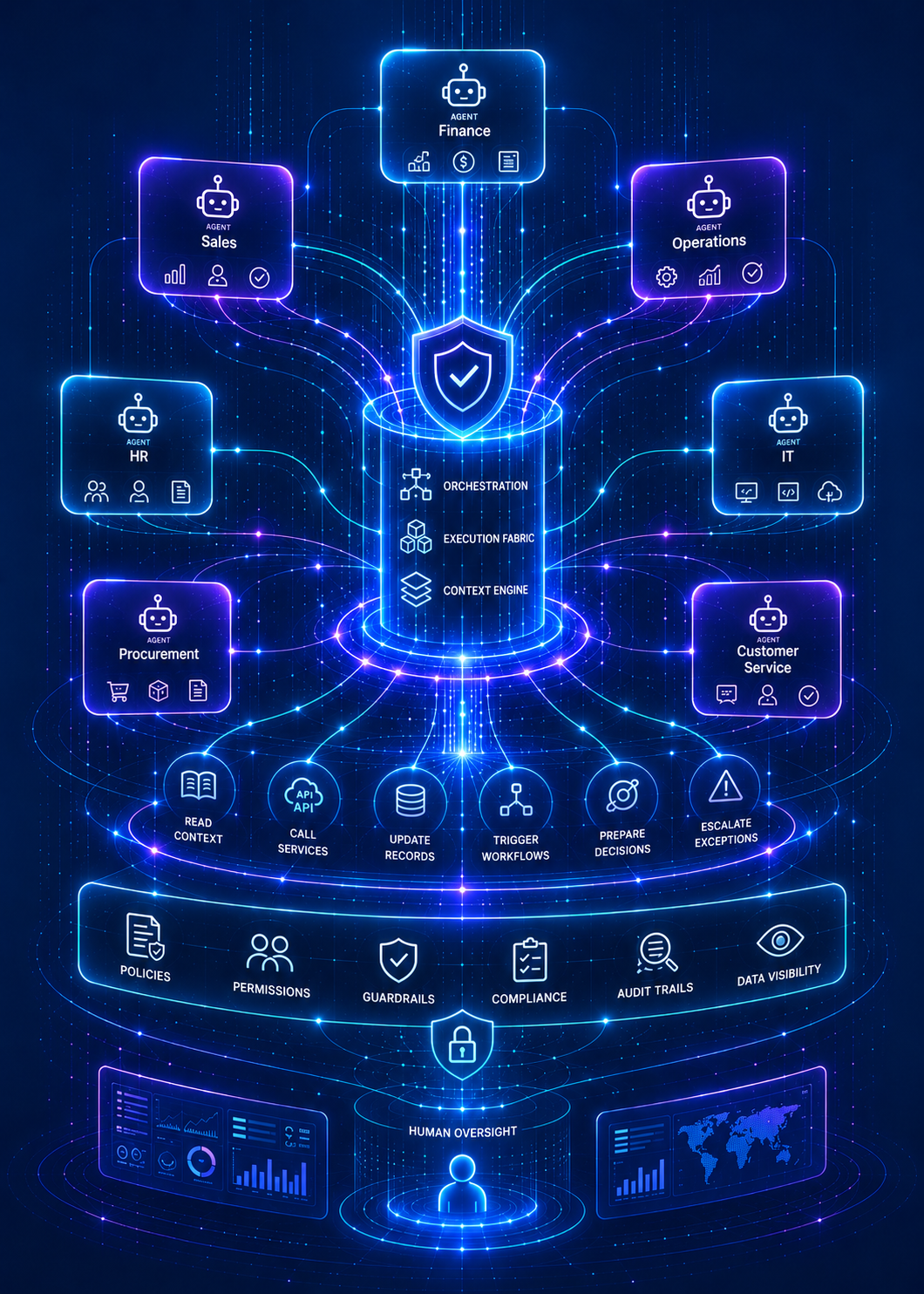
The Advanze Stack - Business Services, Platform Services, Technology Foundation

Agentic operating model

AI agents execute work inside the control model

Advanze treats AI agents as participants in the operating model. Agents can read context, call services, update records, trigger workflows, prepare decisions and escalate exceptions. Human teams remain responsible for judgement, governance and business accountability.

That distinction matters. The goal is not to add another chatbot to existing systems. The goal is to create an execution platform where work can move across functions with consistent permissions, policies, audit trails and data visibility.

Business outcomes

What becomes possible

Fewer silosShared data and workflows reduce duplicated effort.
Faster executionAgents can progress repeatable work across rules, approvals and systems.
Better visibilityLeaders see work, risk and performance in one operating context.
Lower platform sprawlSpecialised capability without another disconnected vendor.
People working through Business Intelligence execution with clarity and confidence.
The outcome is not just automation. It is confidence in what happens next. The person is no longer carrying the full burden alone. Agents assemble context, route specialist checks, pause when judgement is required and record what happened so Business Intelligence work feels calmer, faster and accountable.

Agentic use case

Where Business Intelligence becomes governed execution.

It starts with a person trying to get business intelligence work done without losing context. They need the next action to be clear, but they also need confidence that the platform has checked the risk, evidence, permissions and downstream impact.

What makes it harder in the real world: Business intelligence work looks straightforward until it crosses people, systems, policies, approvals and customer impact. In practice, the work may require the right customer or employee context, policy checks, data quality, approvals, exception routing, integration updates and a clear audit trail.

What Advanze changes: Business Intelligence turns business intelligence activity into governed execution by connecting dashboard, metric, quality, lineage and decision context to agents, workflow, permissions, approvals and audit evidence before work is completed.

Business Intelligence Intake AgentClassifies new business intelligence work, identifies intent, urgency, context requirements and the likely execution path.
Business Intelligence Context AgentGathers related records, history, documents, messages, policies, metrics and system state needed for business intelligence decisions.
Business Intelligence Processing AgentPrepares the recommended action, draft update, workflow step or system change for business intelligence work.
Guardrail AgentChecks permissions, policy thresholds, sensitive data, financial exposure, compliance implications and approval requirements.
Workflow Orchestration AgentRoutes reviews, manages approvals, records evidence and coordinates safe system updates after approval.
Challenge

Business Intelligence starts as a single app experience, but the real work usually depends on context from other teams, policies, data and systems.

Orchestration

Advanze treats Business Intelligence as part of a governed execution fabric. The app captures the work, agents gather context, workflow routes approvals and the control model determines what can safely happen next.

Success

Business Intelligence becomes more than a screen. It becomes a reliable path from intent to controlled action, with people still responsible for judgement and the platform carrying evidence.

Data and business teams reviewing analytics, resilience and recovery evidence.
Data confidence 19Data, analytics and resilience work connecting business decisions to governed evidence.
Data and business teams reviewing analytics, resilience and recovery evidence.
Data confidence 20Data, analytics and resilience work connecting business decisions to governed evidence.
Data and business teams reviewing analytics, resilience and recovery evidence.
Data confidence 21Data, analytics and resilience work connecting business decisions to governed evidence.

Why AI execution needs architecture

The work needs context, controls and clear permissions before automation can safely act.

Business Intelligence is valuable when it participates in the Advanze control model: identity, permissions, workflow, policy checks, data context, audit evidence and human approval boundaries sit inside the execution path.

  • Business Intelligence work needs the right dashboard, metric, quality, lineage and decision context before an agent or user can act with confidence.
  • The process often crosses handoffs, approvals, exception paths, SLAs and downstream system updates.
  • Different actions need different permission levels: read, draft, update, approve, send, pay, create, close or escalate.
  • The business needs evidence of what was requested, what was checked, who approved, what changed and why.

Implementation path

How to move from concept to production

Advanze can be introduced progressively. The recommended path is to start with a visible workflow, prove the operating model, then expand into adjacent capabilities as the platform foundation matures.

  1. 1
    Assess the current operating model

    Map the workflows, systems, data sources and manual coordination points around this capability.

  2. 2
    Design the target execution flow

    Define the data model, human approvals, agent tasks, service calls and governance controls.

  3. 3
    Launch a focused implementation wave

    Start with a bounded use case that proves the operating pattern and creates reusable platform assets.

  4. 4
    Scale across the business

    Extend the pattern to adjacent workflows, more agents, more users and deeper integrations.

Next step

Build this into your execution platform roadmap

Explore how Business Intelligence can be implemented as part of a broader Advanze platform adoption programme, from first pilot to enterprise scale.