Skip to content

Execution Platform

Dataservices

Unified data, services, workflows and agents in one operating substrate.

Dataservices is part of the Advanze platform layer: the execution foundation that enables applications, services and AI agents to work as one operating system for the business. It is designed for extensibility, governance and scale from the start.

Professionals reviewing onboarding evidence and compliance-sensitive customer work.
Dataservices starts with people trying to make the right call. A new customer needs to be onboarded quickly.

Execution Platform / Dataservices

Built as an execution foundation

Advanze is positioned around the idea that enterprise software must evolve from passive systems of record into active systems of execution. In that model, this page is not just a feature description. It explains how Dataservices contributes to an operating environment where people define intent, agents execute governed work, and leadership can see progress through unified data.

The value is strongest when the capability is connected to adjacent processes. Records, workflows, controls, communications and analytics should not live in separate tools. They should participate in a shared execution fabric that can coordinate work across departments while preserving human accountability.

Professionals reviewing onboarding evidence and compliance-sensitive customer work.
Where Dataservices becomes real work people can trust. People reviewing onboarding, evidence and compliance-sensitive customer work with care and control.

Core capabilities

What Dataservices enables

Each capability is designed to work as part of the broader execution platform rather than as a disconnected module.

Hyperscale NoSQL Database

Distributed architecture handles large-scale transactional datasets with resilient access patterns. Automatic sharding and partitioning eliminate manual capacity planning while global replication ensures high availability across regions.

Zero-Configuration Indexing

Intelligent indexing automatically optimizes query performance without manual index creation. Query analyzer identifies access patterns and creates indexes dynamically. Adaptive indexing responds to workload changes automatically.

Built-In Data Resilience

Every table includes point-in-time recovery and continuous backup without additional configuration. Soft-delete protection prevents accidental data loss. Multi-region replication provides disaster recovery out of the box.

Flexible Schema Design

Schemaless JSON documents accommodate evolving data models without migration downtime. Optional schema validation enforces data quality when needed. Polymorphic collections support multiple entity types in single container.

Elastic Scalability

Throughput scales up or down instantly to match workload demands without downtime. Pay only for provisioned capacity with automatic scaling policies. Serverless mode eliminates capacity planning for unpredictable workloads.

Developer-Friendly APIs

Native SDKs for .NET, Python, Node.js and Java provide idiomatic data access. REST and GraphQL endpoints support any language. Change feed streams real-time updates to downstream systems and analytics pipelines.

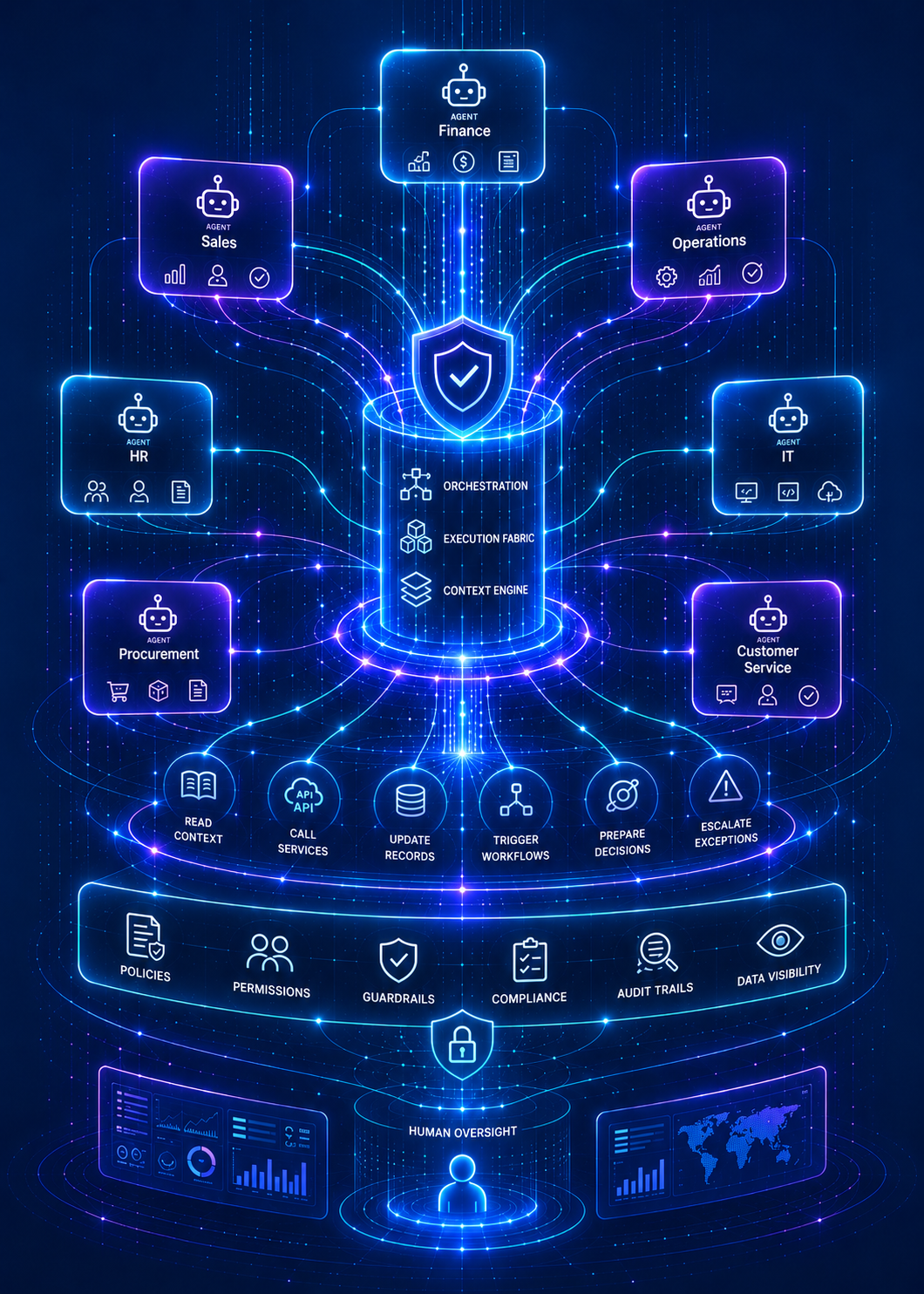
The Advanze Control Model - AI Agents Execute Work Inside the Control Model

Agentic operating model

AI agents execute work inside the control model

Advanze treats AI agents as participants in the operating model. Agents can read context, call services, update records, trigger workflows, prepare decisions and escalate exceptions. Human teams remain responsible for judgement, governance and business accountability.

That distinction matters. The goal is not to add another chatbot to existing systems. The goal is to create an execution platform where work can move across functions with consistent permissions, policies, audit trails and data visibility.

Business outcomes

What becomes possible

Scale by designArchitecture supports growing workloads, data and agent activity.
Governed automationSecurity, identity and controls are embedded in execution paths.
Composable servicesTeams can build faster using reusable platform capabilities.
Operational confidenceTelemetry and auditability make execution observable.
Professionals reviewing onboarding evidence and compliance-sensitive customer work.
The outcome is not just automation. It is confidence in what happens next. When Dataservices runs inside a governed execution model, teams can move faster without losing judgement, accountability or trust.

Agentic use case

Where Dataservices becomes governed execution.

A new customer needs to be onboarded quickly.

What makes it harder in the real world: Onboarding often crosses identity verification, document collection, AML, sanctions, company registry checks, credit, legal terms, customer data quality, workflow approvals and audit evidence.

What Advanze changes: Coordinate onboarding, KYC checks, document review, risk scoring, approvals and customer communication through a governed agentic workflow.

Onboarding AgentGuides the customer journey, checks missing information and coordinates next steps.
KYC AgentRuns identity, address, company, tax, biometric, credit, AML, PEP and sanctions checks where applicable.
Document AgentExtracts, classifies and validates submitted documents.
Risk AgentCombines verification results with risk policies and flags escalations.
Compliance ReviewerApproves medium and high-risk cases or requests additional evidence.
Challenge

Onboarding often crosses identity verification, document collection, AML, sanctions, company registry checks, credit, legal terms, customer data quality, workflow approvals and audit evidence.

Orchestration

Coordinate onboarding, KYC checks, document review, risk scoring, approvals and customer communication through a governed agentic workflow.

Success

Coordinate onboarding, KYC checks, document review, risk scoring, approvals and customer communication through a governed agentic workflow.

Professionals reviewing onboarding evidence and compliance-sensitive customer work.
Onboarding review 1People reviewing onboarding, evidence and compliance-sensitive customer work with care and control.
Professionals reviewing onboarding evidence and compliance-sensitive customer work.
Onboarding review 2People reviewing onboarding, evidence and compliance-sensitive customer work with care and control.
Professionals reviewing onboarding evidence and compliance-sensitive customer work.
Onboarding review 3People reviewing onboarding, evidence and compliance-sensitive customer work with care and control.

Why AI execution needs architecture

The work needs context, controls and clear permissions before automation can safely act.

That is why the Advanze control model matters: identity, permissions, policies, workflow, audit evidence and human judgement are embedded into execution before agents act.

  • Onboarding often crosses identity verification, document collection, AML, sanctions, company registry checks, credit, legal terms, customer data quality, workflow approvals and audit evidence.
  • The right agent must receive the right context, tools, permissions and approval path before work moves forward.
  • Audit evidence, exception handling and human judgement need to be part of the workflow, not notes added after the fact.

Implementation path

How to move from concept to production

Advanze can be introduced progressively. The recommended path is to start with a visible workflow, prove the operating model, then expand into adjacent capabilities as the platform foundation matures.

  1. 1
    Assess the current operating model

    Map the workflows, systems, data sources and manual coordination points around this capability.

  2. 2
    Design the target execution flow

    Define the data model, human approvals, agent tasks, service calls and governance controls.

  3. 3
    Launch a focused implementation wave

    Start with a bounded use case that proves the operating pattern and creates reusable platform assets.

  4. 4
    Scale across the business

    Extend the pattern to adjacent workflows, more agents, more users and deeper integrations.

Next step

Build this into your execution platform roadmap

Explore how Dataservices can be implemented as part of a broader Advanze platform adoption programme, from first pilot to enterprise scale.