Skip to content

Execution Platform

OneSecurity

Unified data, services, workflows and agents in one operating substrate.

OneSecurity is part of the Advanze platform layer: the execution foundation that enables applications, services and AI agents to work as one operating system for the business. It is designed for extensibility, governance and scale from the start.

Security operations team coordinating facility or access response.
OneSecurity starts with people trying to make the right call. An alarm needs a response.

Execution Platform / OneSecurity

Built as an execution foundation

Advanze is positioned around the idea that enterprise software must evolve from passive systems of record into active systems of execution. In that model, this page is not just a feature description. It explains how OneSecurity contributes to an operating environment where people define intent, agents execute governed work, and leadership can see progress through unified data.

The value is strongest when the capability is connected to adjacent processes. Records, workflows, controls, communications and analytics should not live in separate tools. They should participate in a shared execution fabric that can coordinate work across departments while preserving human accountability.

Security operations team coordinating facility or access response.
Where OneSecurity becomes real work people can trust. Operational response scenes for facilities, incidents, access events and controlled escalation.

Core capabilities

What OneSecurity enables

Each capability is designed to work as part of the broader execution platform rather than as a disconnected module.

Physical Security Operations

End-to-end platform for guard companies managing alarm monitoring, guard dispatch and facility security. Integrated workflows coordinate agents, guards and client communications. Real-time dashboards provide operational visibility across all sites and contracts.

Intelligent Alarm Processing

AI agents triage incoming alarms, validate threats and execute response protocols automatically. Reduce false alarms through pattern analysis and contextual validation. Smart escalation ensures genuine threats receive immediate attention.

Guard Tracking & Verification

GPS tracking verifies guard presence at patrol checkpoints and client sites. Agents monitor patrol completion, detect route deviations and flag missed checkpoints. Photo verification at checkpoints ensures guards physically visit each location.

Client Portal & Communications

Self-service portal enables clients to view reports, manage sites and communicate with operations. Automated notifications keep clients informed of alarm events, guard arrivals and incident status. API integration allows clients to embed security data in their systems.

Shift Scheduling & Workforce

Optimize guard scheduling based on site requirements, guard skills and availability constraints. Agents predict staffing needs, handle shift swaps and manage overtime allocation. Integration with payroll systems automates time tracking and billing.

Incident Documentation

Structured incident reporting captures details, evidence and actions taken during security events. Agents assist guards with report generation using voice-to-text and guided workflows. Centralized incident repository enables trend analysis and continuous improvement.

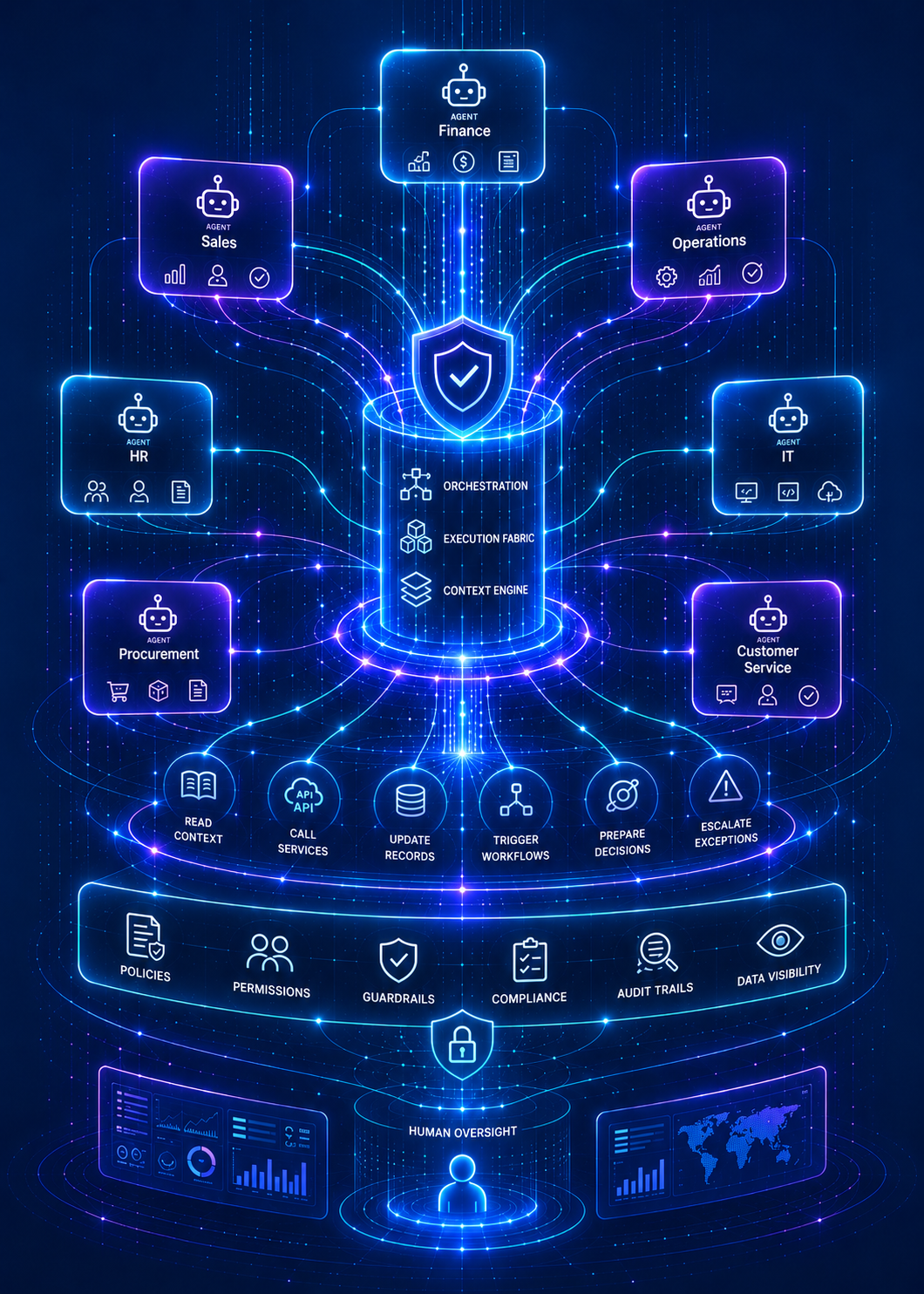
The Advanze Control Model - AI Agents Execute Work Inside the Control Model

Agentic operating model

AI agents execute work inside the control model

Advanze treats AI agents as participants in the operating model. Agents can read context, call services, update records, trigger workflows, prepare decisions and escalate exceptions. Human teams remain responsible for judgement, governance and business accountability.

That distinction matters. The goal is not to add another chatbot to existing systems. The goal is to create an execution platform where work can move across functions with consistent permissions, policies, audit trails and data visibility.

Business outcomes

What becomes possible

Scale by designArchitecture supports growing workloads, data and agent activity.
Governed automationSecurity, identity and controls are embedded in execution paths.
Composable servicesTeams can build faster using reusable platform capabilities.
Operational confidenceTelemetry and auditability make execution observable.
Security operations team coordinating facility or access response.
The outcome is not just automation. It is confidence in what happens next. When OneSecurity runs inside a governed execution model, teams can move faster without losing judgement, accountability or trust.

Agentic use case

Where OneSecurity becomes governed execution.

An alarm needs a response.

What makes it harder in the real world: Alarm response depends on site rules, customer contracts, guard availability, geography, escalation policy, incident evidence, regulatory obligations and duty-of-care controls.

What Advanze changes: Coordinate alarm intake, site context, guard availability, customer instructions, escalation and evidence capture for physical security operations.

Alarm Triage AgentClassifies alarm type, severity, site and response priority.
Site Context AgentRetrieves customer instructions, site layout, access notes and known risks.
Dispatch AgentMatches guard availability, location, skills and response SLA.
Escalation AgentRoutes police, customer or supervisor escalation based on policy.
Evidence AgentCollects incident notes, photos, timestamps and closure evidence.
Challenge

Alarm response depends on site rules, customer contracts, guard availability, geography, escalation policy, incident evidence, regulatory obligations and duty-of-care controls.

Orchestration

Coordinate alarm intake, site context, guard availability, customer instructions, escalation and evidence capture for physical security operations.

Success

Coordinate alarm intake, site context, guard availability, customer instructions, escalation and evidence capture for physical security operations.

Security operations team coordinating facility or access response.
Security operations 3Operational response scenes for facilities, incidents, access events and controlled escalation.
Security operations team coordinating facility or access response.
Security operations 4Operational response scenes for facilities, incidents, access events and controlled escalation.
Security operations team coordinating facility or access response.
Security operations 5Operational response scenes for facilities, incidents, access events and controlled escalation.

Why AI execution needs architecture

The work needs context, controls and clear permissions before automation can safely act.

That is why the Advanze control model matters: identity, permissions, policies, workflow, audit evidence and human judgement are embedded into execution before agents act.

  • Alarm response depends on site rules, customer contracts, guard availability, geography, escalation policy, incident evidence, regulatory obligations and duty-of-care controls.
  • The right agent must receive the right context, tools, permissions and approval path before work moves forward.
  • Audit evidence, exception handling and human judgement need to be part of the workflow, not notes added after the fact.

Implementation path

How to move from concept to production

Advanze can be introduced progressively. The recommended path is to start with a visible workflow, prove the operating model, then expand into adjacent capabilities as the platform foundation matures.

  1. 1
    Assess the current operating model

    Map the workflows, systems, data sources and manual coordination points around this capability.

  2. 2
    Design the target execution flow

    Define the data model, human approvals, agent tasks, service calls and governance controls.

  3. 3
    Launch a focused implementation wave

    Start with a bounded use case that proves the operating pattern and creates reusable platform assets.

  4. 4
    Scale across the business

    Extend the pattern to adjacent workflows, more agents, more users and deeper integrations.

Next step

Build this into your execution platform roadmap

Explore how OneSecurity can be implemented as part of a broader Advanze platform adoption programme, from first pilot to enterprise scale.