Skip to content

Execution Platform

Cybersecurity Platform

Unified data, services, workflows and agents in one operating substrate.

Cybersecurity Platform is part of the Advanze platform layer: the execution foundation that enables applications, services and AI agents to work as one operating system for the business. It is designed for extensibility, governance and scale from the start.

Security and governance professionals reviewing operational risk and evidence.
Cybersecurity Platform starts with people trying to make the right call. An incident needs to be logged and resolved.

Execution Platform / Cybersecurity Platform

Built as an execution foundation

Advanze is positioned around the idea that enterprise software must evolve from passive systems of record into active systems of execution. In that model, this page is not just a feature description. It explains how Cybersecurity Platform contributes to an operating environment where people define intent, agents execute governed work, and leadership can see progress through unified data.

The value is strongest when the capability is connected to adjacent processes. Records, workflows, controls, communications and analytics should not live in separate tools. They should participate in a shared execution fabric that can coordinate work across departments while preserving human accountability.

Security and governance professionals reviewing operational risk and evidence.
Where Cybersecurity Platform becomes real work people can trust. Security, compliance and operations teams coordinating response through evidence and approval boundaries.

Core capabilities

What Cybersecurity Platform enables

Each capability is designed to work as part of the broader execution platform rather than as a disconnected module.

Threat Detection & Response

Continuous monitoring across endpoints, networks, applications and cloud infrastructure. AI agents correlate security events, identify attack patterns, prioritize alerts by risk and trigger automated containment workflows to stop threats before they cause damage.

Vulnerability Management

Scan assets for known vulnerabilities, misconfigurations and compliance gaps. Automated agents prioritize remediation based on exploitability, business impact and threat intelligence while tracking patching progress and exception approvals through governed workflows.

Identity & Access Governance

Centralized identity lifecycle management, role-based access control and privilege governance. Agents detect anomalous access patterns, enforce least-privilege principles, orchestrate access reviews and revoke orphaned permissions across enterprise systems.

Compliance & Audit

Continuous compliance monitoring for security management controls, independent assurance, NIST, payment controls DSS and industry-specific frameworks. Automated evidence collection, control testing and audit trail generation reduce manual effort while proving security posture to auditors and regulators.

Incident Management

Structured incident response workflows coordinate security teams, preserve forensic evidence, communicate with stakeholders and track remediation. Agents enrich alerts with context, suggest response playbooks and escalate based on severity thresholds.

Security Analytics & Reporting

Executive dashboards visualize security posture, risk trends and program maturity. Track metrics like mean time to detect, time to contain, vulnerability aging and control effectiveness. AI-generated summaries explain changes and recommend focus areas.

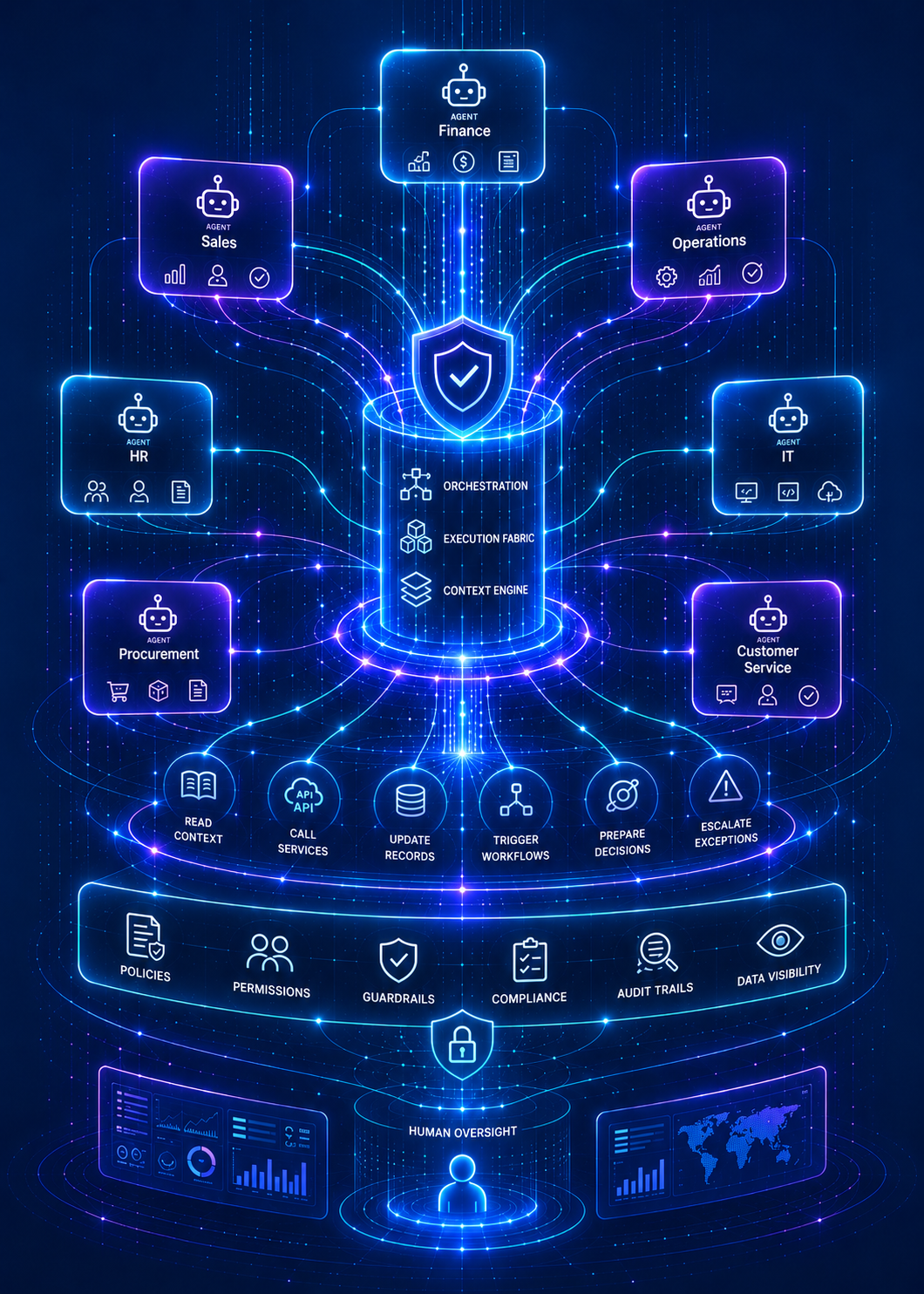
The Advanze Control Model - AI Agents Execute Work Inside the Control Model

Agentic operating model

AI agents execute work inside the control model

Advanze treats AI agents as participants in the operating model. Agents can read context, call services, update records, trigger workflows, prepare decisions and escalate exceptions. Human teams remain responsible for judgement, governance and business accountability.

That distinction matters. The goal is not to add another chatbot to existing systems. The goal is to create an execution platform where work can move across functions with consistent permissions, policies, audit trails and data visibility.

Business outcomes

What becomes possible

Scale by designArchitecture supports growing workloads, data and agent activity.
Governed automationSecurity, identity and controls are embedded in execution paths.
Composable servicesTeams can build faster using reusable platform capabilities.
Operational confidenceTelemetry and auditability make execution observable.
Security and governance professionals reviewing operational risk and evidence.
The outcome is not just automation. It is confidence in what happens next. When Cybersecurity Platform runs inside a governed execution model, teams can move faster without losing judgement, accountability or trust.

Agentic use case

Where Cybersecurity Platform becomes governed execution.

An incident needs to be logged and resolved.

What makes it harder in the real world: Incidents may involve customer impact, cyber risk, legal notification, regulatory timelines, operational disruption, SLA exposure, root-cause analysis and executive communication.

What Advanze changes: Coordinate incident intake, severity classification, evidence collection, stakeholder notification, escalation and remediation tasks through governed agentic workflow.

Triage AgentClassifies incident type, severity, affected systems and urgency.
Evidence AgentCollects logs, records, screenshots, ticket history and related events.
Security AgentChecks whether the event involves cyber, data loss, access compromise or suspicious activity.
Compliance AgentChecks regulatory notification, policy requirements and audit obligations.
Communications AgentDrafts internal updates, customer notices and executive summaries for approval.
Challenge

Incidents may involve customer impact, cyber risk, legal notification, regulatory timelines, operational disruption, SLA exposure, root-cause analysis and executive communication.

Orchestration

Coordinate incident intake, severity classification, evidence collection, stakeholder notification, escalation and remediation tasks through governed agentic workflow.

Success

Coordinate incident intake, severity classification, evidence collection, stakeholder notification, escalation and remediation tasks through governed agentic workflow.

Security and governance professionals reviewing operational risk and evidence.
Security governance 3Security, compliance and operations teams coordinating response through evidence and approval boundaries.
Security and governance professionals reviewing operational risk and evidence.
Security governance 4Security, compliance and operations teams coordinating response through evidence and approval boundaries.
Security and governance professionals reviewing operational risk and evidence.
Security governance 5Security, compliance and operations teams coordinating response through evidence and approval boundaries.

Why AI execution needs architecture

The work needs context, controls and clear permissions before automation can safely act.

That is why the Advanze control model matters: identity, permissions, policies, workflow, audit evidence and human judgement are embedded into execution before agents act.

  • Incidents may involve customer impact, cyber risk, legal notification, regulatory timelines, operational disruption, SLA exposure, root-cause analysis and executive communication.
  • The right agent must receive the right context, tools, permissions and approval path before work moves forward.
  • Audit evidence, exception handling and human judgement need to be part of the workflow, not notes added after the fact.

Implementation path

How to move from concept to production

Advanze can be introduced progressively. The recommended path is to start with a visible workflow, prove the operating model, then expand into adjacent capabilities as the platform foundation matures.

  1. 1
    Assess the current operating model

    Map the workflows, systems, data sources and manual coordination points around this capability.

  2. 2
    Design the target execution flow

    Define the data model, human approvals, agent tasks, service calls and governance controls.

  3. 3
    Launch a focused implementation wave

    Start with a bounded use case that proves the operating pattern and creates reusable platform assets.

  4. 4
    Scale across the business

    Extend the pattern to adjacent workflows, more agents, more users and deeper integrations.

Next step

Build this into your execution platform roadmap

Explore how Cybersecurity Platform can be implemented as part of a broader Advanze platform adoption programme, from first pilot to enterprise scale.