
Omnichannel Service
Handle customer interactions across email, chat, phone, portal and messaging through a unified service platform. Agents see complete customer context regardless of which channel the customer uses.
Elevate & Transform
From manual coordination to measurable execution outcomes.
Transform Customer Service focuses on a business outcome rather than a software module. Advanze helps organisations move beyond manual coordination by giving teams, systems and AI agents one shared execution platform.

Business Objective / Transform Customer Service
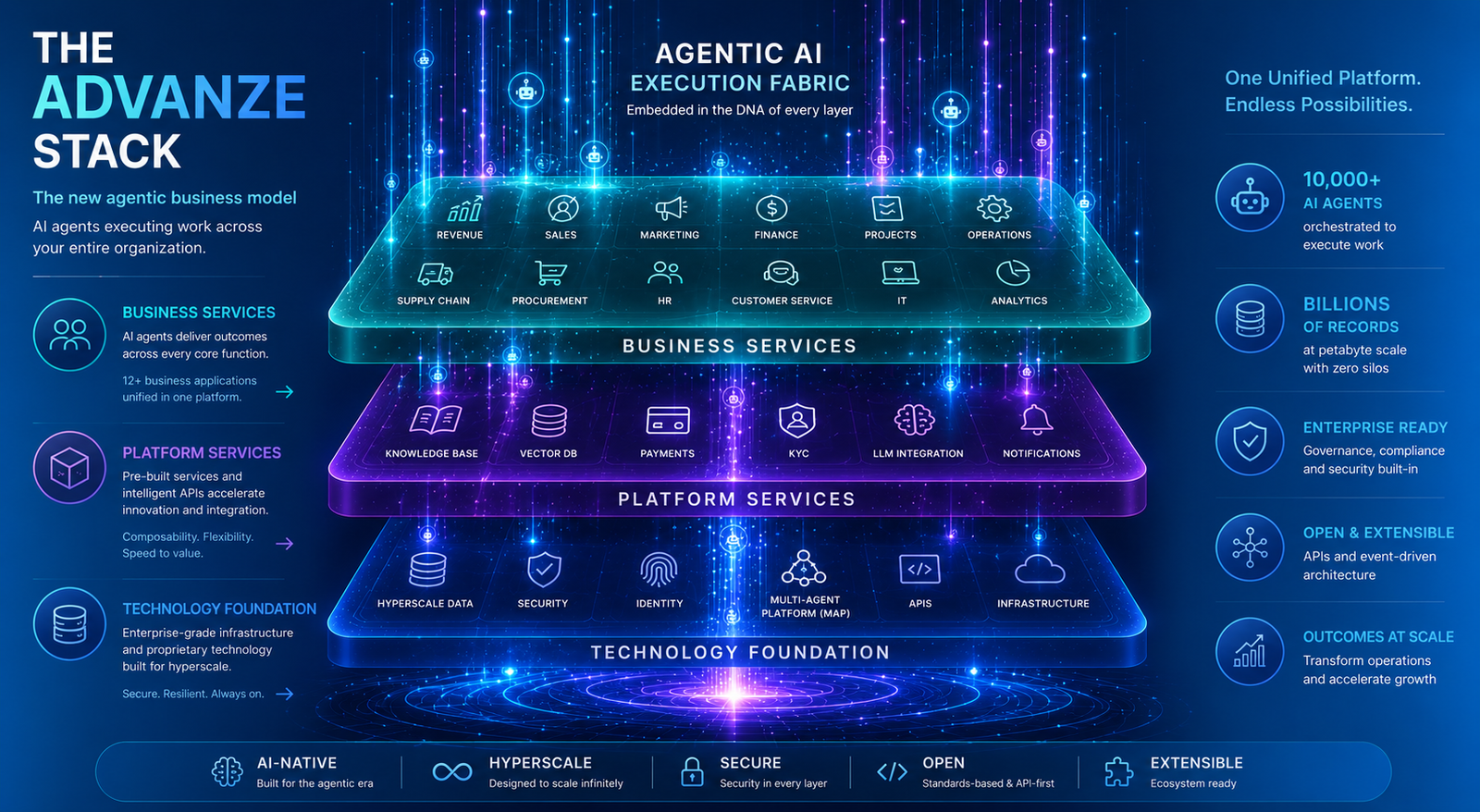
Advanze is positioned around the idea that enterprise software must evolve from passive systems of record into active systems of execution. In that model, this page is not just a feature description. It explains how Transform Customer Service contributes to an operating environment where people define intent, agents execute governed work, and leadership can see progress through unified data.
The value is strongest when the capability is connected to adjacent processes. Records, workflows, controls, communications and analytics should not live in separate tools. They should participate in a shared execution fabric that can coordinate work across departments while preserving human accountability.

Core capabilities
Each capability is designed to work as part of the broader execution platform rather than as a disconnected module.
Handle customer interactions across email, chat, phone, portal and messaging through a unified service platform. Agents see complete customer context regardless of which channel the customer uses.
Route incoming requests to the best handler based on content, urgency, skill requirements and capacity. AI agents handle routine inquiries directly while escalating complex cases to human specialists with full context.
Track service requests from intake through resolution with automated workflows, service target monitoring and escalation rules. All case history, communications and actions are captured in a unified record.
Surface relevant knowledge articles and solutions during case handling. AI agents can search, summarize and recommend content while learning from resolution patterns to improve future recommendations.
Monitor response times, resolution rates, customer satisfaction and agent productivity through real-time dashboards. Analytics identify training needs, process improvements and capacity requirements.
Capture resolution patterns and customer feedback to refine service processes and agent training. Historical data enables proactive service improvements and automated response optimization.
Agentic operating model
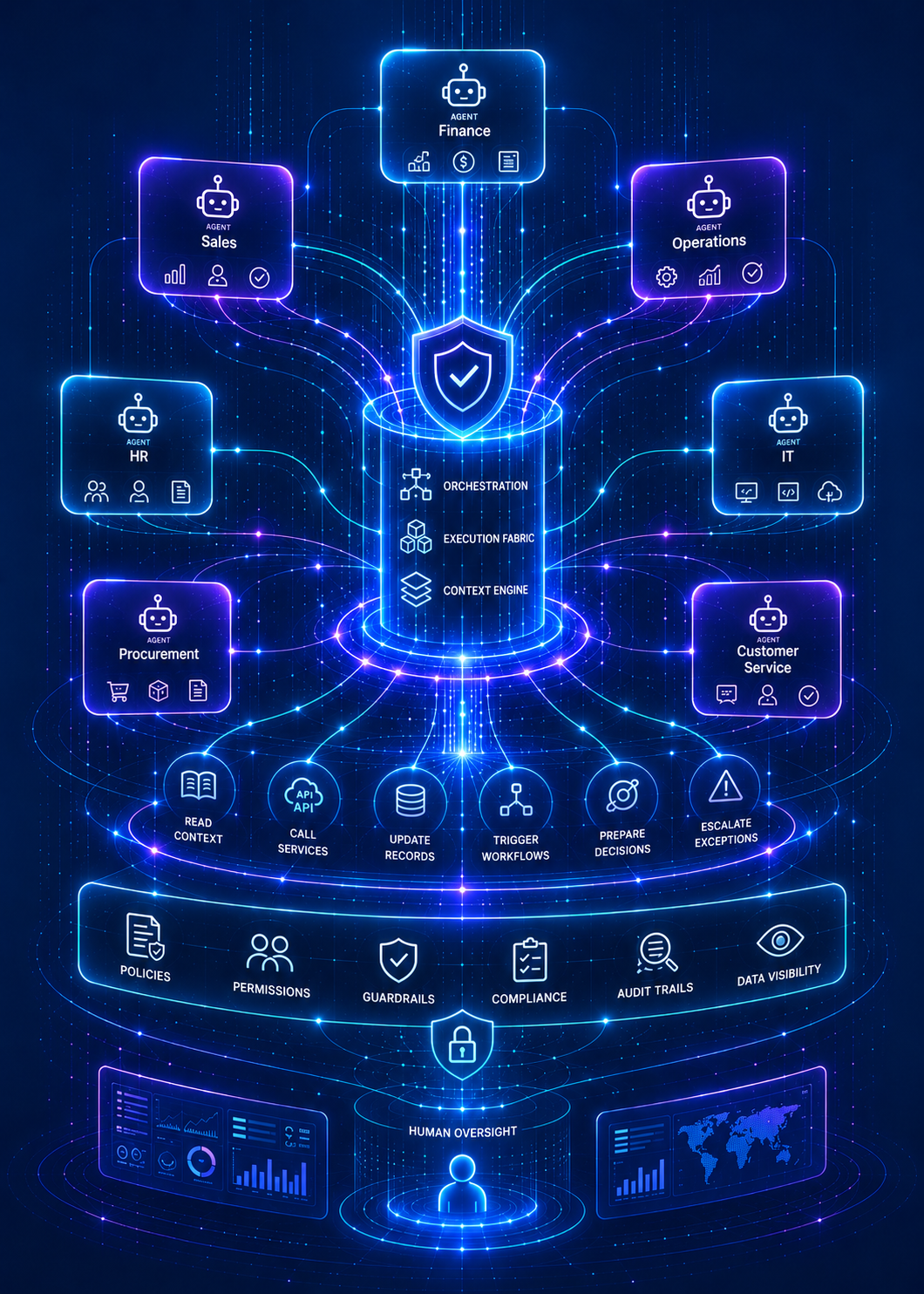
Advanze treats AI agents as participants in the operating model. Agents can read context, call services, update records, trigger workflows, prepare decisions and escalate exceptions. Human teams remain responsible for judgement, governance and business accountability.
That distinction matters. The goal is not to add another chatbot to existing systems. The goal is to create an execution platform where work can move across functions with consistent permissions, policies, audit trails and data visibility.
Business outcomes

Agentic use case
A customer support ticket needs an answer.
What makes it harder in the real world: Support answers can depend on customer entitlement, product version, SLA, open incidents, contractual commitments, data sensitivity and whether a system action is safe.
What Advanze changes: Coordinate support triage, knowledge search, customer context, entitlement checks, escalation, response drafting and case updates through a controlled workflow.
Support answers can depend on customer entitlement, product version, SLA, open incidents, contractual commitments, data sensitivity and whether a system action is safe.
Coordinate support triage, knowledge search, customer context, entitlement checks, escalation, response drafting and case updates through a controlled workflow.
Coordinate support triage, knowledge search, customer context, entitlement checks, escalation, response drafting and case updates through a controlled workflow.


Why AI execution needs architecture
That is why the Advanze control model matters: identity, permissions, policies, workflow, audit evidence and human judgement are embedded into execution before agents act.
Implementation path
Advanze can be introduced progressively. The recommended path is to start with a visible workflow, prove the operating model, then expand into adjacent capabilities as the platform foundation matures.
Map the workflows, systems, data sources and manual coordination points around this capability.
Define the data model, human approvals, agent tasks, service calls and governance controls.
Start with a bounded use case that proves the operating pattern and creates reusable platform assets.
Extend the pattern to adjacent workflows, more agents, more users and deeper integrations.
Next step
Explore how Transform Customer Service can be implemented as part of a broader Advanze platform adoption programme, from first pilot to enterprise scale.